Don't Buy Until You Read This: Ugreen Nexode 500W 6 Port Charger vs Samsung Galaxy Z Flip 7
Choosing between accessories and devices can be unexpectedly complicated. Two very different products — the Ugreen Nexode 500W 6 Port Charger and the Samsung Galaxy Z Flip 7 — often appear together in shoppers' baskets because they solve complementary problems: one keeps multiple devices powered, the other is a compact, foldable smartphone designed to replace a conventional slab. This article breaks down how each product performs in real-world use, what buyers typically care about, and how to decide which deserves priority when budgeting or packing. The goal is to provide a practical, non-hype comparison so readers can make an informed purchase decision.
Introduction
Power delivery and mobile hardware have converged into a single buying question for many people: how to keep a phone, laptop, tablet, watch, earbuds and more charged without carrying a drawer of chargers and cables. The Ugreen Nexode 500W 6 Port Charger promises to centralize power with a compact footprint and multiple high-power ports. Meanwhile, the Samsung Galaxy Z Flip 7 promises pocketable modern smartphone capability through its folding form factor. Both appeal to travelers, commuters, and anyone trying to simplify their daily gear, but they answer different needs. This article evaluates each product on practical performance, compatibility, durability, value, and who should prioritize which purchase.
Ugreen Nexode 500W 6 Port Charger — Detailed Analysis
The Ugreen Nexode 500W aims to replace several single-port chargers with a single multiport hub. For real-world users, the key questions are: does it reliably deliver advertised power to the devices that need it, is it safe under sustained load, how does it behave with combinations of devices, and is it convenient to carry and use?
Design and Build
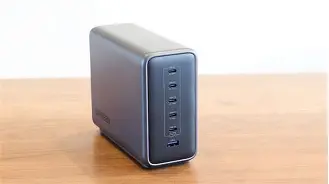
In everyday use the charger’s value starts with its physical footprint and cable management. Buyers report that multiport chargers like the Nexode significantly reduce clutter on a desk or in luggage. The device’s construction typically uses thermally managed plastics and internal circuitry that supports GaN (gallium nitride) technology, which allows high-power delivery in a smaller package than older silicon-based chargers. For the user, that means smaller size and lighter weight compared with carrying multiple brick chargers.
Power Delivery and Port Configuration
The 500W figure in the product name denotes the maximum combined output the unit can deliver. Practical buyers should understand two points: first, only a subset of ports can deliver the highest single-port wattages useful for laptops, and second, total output is shared among all connected devices. Real-world usage scenarios—charging a laptop while powering a tablet and phone—rely on sensible distribution rules built into the charger’s firmware. Users who need full laptop speeds while also charging many accessories should verify the port-to-port power allocation and plan accordingly.
Compatibility and Safety
Compatibility with USB Power Delivery (PD) profiles, Quick Charge variants, and legacy USB-A devices matters. Buyers should verify whether their laptop accepts PD over USB-C and whether the charger negotiates the correct PD profiles to avoid slow or restricted charging. On safety, modern multiport chargers include over-current, over-voltage, short-circuit, and thermal protection. For those who charge expensive devices or leave charging unattended (such as overnight or during travel), these protections are critical.
Find top-rated Mobile Phones products at great prices.
See Deals →Real-World Use Cases
- Family travel: One charger on the hotel desk charges phones, a tablet, a portable gaming device, and a laptop without fighting for outlets.
- Home workstation: Declutters the charging area and powers a laptop and peripherals with a single outlet.
- Frequent flyers: Reduces carry weight — one charger instead of multiple specialized bricks.
- Shared spaces: Simplifies charging in co-working desks or meeting rooms where outlet access is limited.
What Buyers Typically Care About
Shoppers prioritize port availability, the ability to charge a laptop at full speed, heat under load, warranty/support, cable requirements, and real-world reliability. An inexpensive multiport hub that overheats, throttles under load, or refuses to drive a laptop at advertised wattage will be a poor investment despite attractive marketing numbers.
Samsung Galaxy Z Flip 7 — Detailed Analysis
The Samsung Galaxy Z Flip series has always targeted users who want a compact device that unfolds into a full-sized smartphone. The market appeal is fashion-forward portability combined with flagship-level features. For prospective buyers, practical concerns include hinge durability, battery life, camera performance, software maturity, and how the foldable design fits into daily habits like pocket carrying and one-handed use.
Design, Hinge, and Durability
Foldable phones are judged on their hinge engineering and crease behavior. Buyers should look for robust hinge improvemen…
Display and Everyday Use
When unfolded the Flip offers a standard smartphone display experience with the added bonus of compact storage when folded. The outer cover screen has become more functional over successive generations, enabling notifications, quick replies, camera preview, and widgets without opening the phone. For many users this changes charging and interaction habits: quick checks are done on the cover screen, reducing the number of full open/close cycles and conserving battery.
Camera and Performance
Flagship foldables aim to match the camera and performance of non-folding competitors while adding unique photographic modes enabled by the hinge (for example, tent mode hands-free shots). Buyers who prioritize photography should compare sample images in varied lighting and verify whether optical stabilization, night modes, and software processing meet their expectations. Performance for everyday tasks, gaming, and multitasking will be determined by the chipset and thermal management; most buyers expect snappy gesture navigation, responsive multitasking, and smooth animations.
Looking for the best Mobile Phones deals on Amazon?
View Offers →Battery Life and Charging
Battery life is a primary concern because foldables pack two displays and a hinge mechanism without necessarily increasing battery size. Buyers typically weigh screen-on time, mixed-use endurance, and how quickly the phone charges. Fast charging support reduces time tethered to a cable, and wireless charging adds convenience. Practical users should consider whether the phone’s battery and charging profile align with their daily routine—long days away from an outlet, or short top-ups between meetings.
Real-World Use Cases
- Commuters: Compact folded size fits into urban clothing with small pockets; quick checks on the outer screen avoid opening a full device at stops.
- Content creators: Flexible shooting angles and tent mode can be useful for vlogging and social media capture.
- Multitaskers: Multitasking on a foldable can be compelling, but depends heavily on software optimizations and the user's workflow.
- Style-conscious buyers: The Flip appeals to those who value a device that stands out and doubles as a fashion accessory.
Pros & Cons
Ugreen Nexode 500W 6 Port Charger
- Pros: Consolidates multiple chargers into a single unit; high combined wattage for charging many devices at once; compact GaN-style design reduces size and weight; useful for travel and shared outlets.
- Cons: Total wattage is shared across ports, so multi-device use can limit single-device peak charging; requires quality cables for best performance; can generate heat under sustained heavy load; port allocation can be confusing without reading the manual.
Samsung Galaxy Z Flip 7
- Pros: Pocketable folded size with full-sized unfolded display; modern hinge and software features allow new use patterns; cover display increases convenience; typically flagship-level cameras and performance.
- Cons: Foldables often cost more than comparable non-folding phones; battery life can be less than larger non-folding devices; cases and screen protection options are more limited; long-term hinge durability remains a buyer concern despite improvements.
Comparison Table
| Aspect | Ugreen Nexode 500W 6 Port Charger | Samsung Galaxy Z Flip 7 |
|---|---|---|
| Primary purpose | Centralized multi-device power delivery for travel, home, and office | Compact, foldable smartphone for daily communication and media |
| Portability | Designed to be portable — replaces several bulky chargers | Highly portable when folded — fits smaller pockets |
| Real-world value | Reduces clutter and outlet competition; valuable for multi-device households | Combines flagship features with a unique form factor; valuable for users prioritizing pocketability and style |
| Compatibility concerns | Check PD profiles and port power distribution for laptops and gaming devices | Case and screen protection compatibility; hinge and long-term durability |
| Who benefits most | Travelers, families, people with multiple USB-powered devices | Users seeking a compact phone that behaves like a flagship when open |
| Cost considerations | Upfront cost can be justified by replacing multiple chargers | Premium device cost; value tied to how much the foldable form factor matters |
Buying Guide: How to Decide
Deciding between buying a high-capacity charger or a new foldable phone is not a strict either/or — many buyers will purchase both over time. The more practical question is which to prioritize now, and what to check for before buying.
Prioritization Checklist
- If clutter and multiple devices are a problem: prioritize the multiport charger. The convenience of one outlet powering a laptop, phone, tablet, and accessories is immediate and tangible.
- If the phone is old and daily use is suffering: prioritize the smartphone. A device that’s slow, has poor battery life, or a cracked screen impacts daily communication, navigation, photography, and apps.
- If traveling light is a frequent requirement: both items make sense. The charger reduces brick count; a compact foldable reduces pocket bulk.
- If budget is tight: consider which product relieves the most pain point. A reliable charger can protect multiple devices and provide long-term savings; a new phone can improve productivity and experience but is costlier.
What to Verify Before Buying a Multiport Charger
- Confirm the charger supports the required PD or quick-charge protocol for your most power-hungry device (typically a laptop).
- Check port-to-port power distribution diagrams so the charger can drive your specific device combination at useful speeds.
- Inspect safety certifications and built-in protections, particularly for heavy or unattended charging.
- Plan for high-quality cables. Even the best charger underperforms with cheap or damaged cables.
- Consider weight and plug size if international travel is expected; some plugs may require an adapter or be bulkier.
What to Verify Before Buying a Foldable Phone
- Look for independent hinge durability testing and manufacturer claims about lifecycle cycles (how many open/close cycles are guaranteed).
- Compare battery endurance in real-world mixed-use scenarios rather than just benchmark numbers. Folding phones can have different thermal and power profiles.
- Assess the outer cover screen’s functionality: notifications, widgets, camera preview — this determines how often the user will avoid opening the device.
- Evaluate camera samples across lighting conditions and consider whether the device’s photographic strengths align with the buyer’s priorities (social media, travel, low-light photography).
- Consider the accessories ecosystem: cases, screen protectors, and service options matter for long-term ownership.
Practical Tips for Both Purchases
- Read user reports and verified reviews that show long-term use, not just initial impressions.
- Check warranty and support policies. A good warranty matters more for higher-cost items and electronics that get frequent use.
- Test in person when possible: feel the hinge, try one-handed tasks on a foldable, and see how the charger fits into a bag or outlet layout.
- Factor in ecosystem benefits: some chargers and phones work better when paired with vendor accessories and services.
Conclusion
The Ugreen Nexode 500W 6 Port Charger and the Samsung Galaxy Z Flip 7 solve different everyday problems but both deserve careful consideration before purchase. For those burdened by multiple chargers, limited outlets, and frequent travel, a high-capacity multiport charger delivers immediate, practical value by consolidating power and simplifying cable management. For users who prioritize pocketability, style, and a distinctive interaction model, a foldable like the Flip provides a unique experience that can improve day-to-day convenience and creativity.
Ultimately, the right choice depends on which problem the buyer needs solved most urgently. If the priority is to reduce clutter and always have devices powered, the charger should come first. If the phone itself is the bottleneck for daily productivity or enjoyment, upgrading the smartphone will likely have a larger impact. In many cases, both purchases complement one another: a compact, high-capacity charger keeps a cutting-edge foldable topped up and ready for use. Readers are encouraged to weigh compatibility, real-world power distribution, long-term durability, and warranty support when making a decision.