Head-to-Head: Panasonic Hc X1200 vs Dji Osmo Action 6 (Detailed Comparison)
In the rapidly evolving landscape of digital imaging, the choice between a dedicated professional camcorder and a high-end action camera has never been more complex. Today, we are diving deep into a comparison that highlights the fundamental differences in videography philosophy: the Panasonic HC-X1200 professional 4K camcorder and the DJI Osmo Action 6. While these two devices inhabit the same category of "video recording tools," they serve drastically different masters and use cases.
The Panasonic HC-X1200 is built for the professional who requires manual control, long-form recording stability, and high-fidelity internal processing. On the other hand, the DJI Osmo Action 6 represents the pinnacle of ruggedized, high-frame-rate capture designed to survive environments that would destroy a traditional lens system. This article explores how these two powerhouses stack up in terms of image quality, ergonomics, specialized features, and overall value for the modern content creator.
Understanding the Contenders: Professionalism vs. Portability
Before jumping into the specifications, it is essential to define what these cameras are. The Panasonic HC-X1200 is one of the industry's smallest and lightest 4K/60p professional camcorders. It utilizes a 1/2.5-type sensor and a built-in Leica Dicomar lens, offering an expansive 24x optical zoom. It is a tool for the documentary filmmaker, the event videographer, and the "run-and-gun" journalist who needs XLR audio inputs and physical rings for focus and iris.

The DJI Osmo Action 6 is the latest evolution in DJI's action camera lineage. Built around a larger sensor relative to its body size, it focuses on extreme stabilization, 10-bit color depth, and a waterproof, shockproof chassis. It is the tool of choice for athletes, travel vloggers, and creators who need a camera that can be mounted to a helmet, a car, or a surfboard without a second thought. While the HC-X1200 brings the studio to the field, the Osmo Action 6 brings the field to the viewers in high-octane detail.
Panasonic HC-X1200: The Precision Instrument
The Panasonic HC-X1200 is designed for those who cannot afford to miss a shot due to technical limitations. Its standout feature is the integrated lens system. Unlike mirrorless cameras, you don't swap lenses here; instead, you get a 25mm wide-angle to 600mm telephoto reach (35mm equivalent). This allows a videographer to capture a wide crowd shot and then instantly zoom in on a speaker’s face at the back of a hall without swapping glass or losing focus.
Internally, the HC-X1200 is a beast. It supports 4K 60p recording at 4:2:2 10-bit internally (up to 30p), which is vital for color grading and broadcast standards. The inclusion of two XLR audio inputs means you can plug in professional shotgun or lavalier microphones directly into the body, bypassing the need for external recorders. Furthermore, its built-in ND filters (1/4, 1/16, 1/64) allow for shooting in bright daylight while maintaining a shallow depth of field or a specific shutter angle.
Pros and Cons of the Panasonic HC-X1200
- Pro: Massive 24x optical zoom range provides incredible versatility for events and wildlife without losing resolution.
- Pro: Dual XLR inputs allow for professional-grade audio capture without external synchronization.
- Pro: Built-in physical ND filters are a lifesaver for maintaining exposure control in changing light.
- Pro: High-efficiency video coding (HEVC) allows for 10-bit recording without massive file sizes.
- Pro: Outstanding heat management allows for unlimited recording times in most environments.
- Con: The 1/2.5-inch sensor is smaller than many modern mirrorless cameras, which can lead to noise in very low-light situations.
- Con: It is significantly bulkier than an action camera, requiring a dedicated bag and more setup time.
- Con: Fixed lens means you are stuck with the aperture limitations of the built-in glass.
DJI Osmo Action 6: The Rugged Storyteller
The DJI Osmo Action 6 takes a different approach. It leverages a large 1/1.3-inch sensor, which surprisingly outperforms the Panasonic in raw low-light sensor performance per square millimeter. Because it is designed for action, it features "RockSteady" and "HorizonSteady" digital stabilization that mimics the look of a motorized gimbal. This allows the camera to stay level even if it is flipped 360 degrees during a stunt.
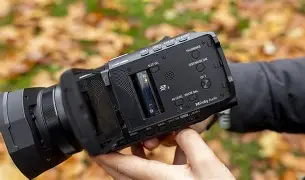
Where the DJI shines is in its "POV" (point of view) capability. Its ultra-wide 155-degree field of view captures everything in the periphery, making it ideal for immersive travel content. The dual-touchscreen design—one on the back and one on the front—makes framing selfies and vlogs effortless. It also features a magnetic quick-release system, allowing the user to snap the camera off a tripod and onto a chest mount in seconds.
Pros and Cons of the DJI Osmo Action 6
- Pro: Extremely compact and durable; waterproof up to 18 meters without a housing.
- Pro: The 1/1.3-inch sensor provides excellent dynamic range and better low-light performance than typical action cams.
- Pro: Industry-leading stabilization makes handheld footage look professional and smooth.
- Pro: Dual color touchscreens allow for easy framing from any angle.
- Pro: Fast charging capabilities allow the battery to reach 80% in under 20 minutes.
- Con: Fixed focal length means you cannot zoom in on distant subjects without significant digital degradation.
- Con: Limited audio inputs (requires adapters for professional mics).
- Con: Small form factor can lead to overheating when recording at maximum settings (4K/120fps) for extended periods.
- Con: Lacks the mechanical control (aperture/focus rings) found on pro camcorders.
Feature Comparison Table
To help visualize the technical gap between these two devices, refer to the table below which highlights the core specifications side-by-side.
Discover deals on Cameras & Photography — updated daily.
Browse Now →| Feature | Panasonic HC-X1200 | DJI Osmo Action 6 |
|---|---|---|
| Sensor Size | 1/2.5-inch MOS | 1/1.3-inch CMOS |
| Max Resolution | 4K (3840 x 2160) @ 60p | 4K (3840 x 2160) @ 120p |
| Optical Zoom | 24x (25mm - 600mm) | None (Fixed Wide) |
| Audio Inputs | 2x XLR, 1x 3.5mm Jack | USB-C (Requires Adapter) |
| Stabilization | 5-Axis Hybrid O.I.S. | RockSteady 3.0+ / HorizonSteady |
| Durability | Standard (Frangible) | Waterproof, Shockproof, Freezeproof |
| ND Filters | Built-in (3 stages) | External (Optional Accessories) |
| Battery Life | Long (Replaceable large packs) | Moderate (Fast-charging) |
Deep Dive: Image Quality and Color Science
When we talk about image quality, we must look beyond resolution. Both cameras shoot in 4K, but the texture of that 4K is very different. The Panasonic HC-X1200 uses a Leica Dicomar lens system which is engineered for edge-to-edge sharpness and minimal chromatic aberration. It produces a "clinical" and realistic image. Because it captures 10-bit color, the gradations in a blue sky or the skin tones of an interview subject are smooth and natural. The Panasonic is the choice for work that will be viewed on large screens where compression artifacts would be glaring.
The DJI Osmo Action 6, conversely, focuses on "pop." Out of the box, the colors are vibrant, and the sharpening is more aggressive to compensate for the wide-angle lens. However, DJI has included a 10-bit D-Log M color profile, which provides a flatter image for editors to color grade manually. In low light, the DJI actually has a slight advantage in terms of raw sensor noise thanks to the larger pixels on its 1/1.3-inch sensor, but the Panasonic's ability to maintain a constant aperture or slow down the shutter via ND filters often offsets this in professional hands.
Real-World Use Cases: Where Each Camera Wins
Buying the "best" camera is actually about buying the right tool for the specific job. Let's look at a few scenarios to see how these cameras perform in the field.
Scenario 1: Live Event Coverage (Weddings, Conferences)
The Panasonic HC-X1200 is the clear winner here. During a wedding, the videographer needs to quickly move from a wide shot of the altar to a close-up of the ring exchange. The 24x optical zoom allows this without moving the tripod. Furthermore, the dual XLR inputs allow the videographer to take a direct feed from the DJ's soundboard while keeping a backup shotgun mic on the other channel. The DJI would struggle with the distance and the audio requirements of this setting.
Scenario 2: Action Sports and Mountain Biking
The DJI Osmo Action 6 is the undisputed champion of the trails. Mounting the Panasonic to a handlebar wou…Scenario 3: Documentary and News Gathering
This is a middle ground, but it usually leans toward the Panasonic. Journalists need the reliability of physical buttons. Changing the iris or white balance via a touchscreen (as on the DJI) is slower than turning a ring or flipping a switch. The Panasonic also supports "Background Recording," where one SD card records continuously while the other records only when the start/stop button is pressed—a vital feature for capturing unexpected moments in news environments.
The Buying Guide: How to Choose
If you are still on the fence, consider the following factors as your primary decision drivers:
1. Distance from Subject: If your subject is more than 10 feet away and you need to see their facial expressions, you need the Panasonic. Action cameras like the DJI are designed for subjects within an arm's reach or for massive landscapes where everything is in focus.
2. Audio Importance: If your video is 50% audio (interviews, podcasts, musical performances), the Panasonic saves you hours of work in post-production. If you mostly use background music or a simple voiceover recorded later, the DJI's internal mics (which are decent but limited) will suffice.
Find top-rated Cameras & Photography products at great prices.
Shop Amazon →3. Environment: Will you be in the rain? On a boat? In a dusty desert? The DJI is a tank. The Panasonic is a delicate piece of optical equipment. While the Panasonic has a sturdy build, it is not sealed against the elements in the same way.
4. Post-Production Workflow: If you want to record, transfer to your phone, and post to social media in five minutes, the DJI's ecosystem is built for you. If you are going into DaVinci Resolve or Adobe Premiere to craft a 20-minute cinematic piece, the 10-bit files from the Panasonic provide the "meat" you need for a professional grade.
Technical Ergonomics and Battery Life
Ergonomics play a huge role in long-term satisfaction. The Panasonic HC-X1200 is designed to be held for hours. It has a hand strap that shifts the weight onto your palm and an electronic viewfinder (EVF) that allows you to shoot in bright sunlight when the LCD screen becomes washed out. It uses large batteries that can power the unit for 3+ hours of continuous recording.
The DJI Osmo Action 6 is designed for "bursts" of creativity. While it can record for a long time, holding a tiny square for an hour-long speech is uncomfortable and results in shaky footage. Its batteries are small and designed to be swapped frequently. However, DJI's Extreme Battery technology is impressive, functioning in temperatures as low as -20°C, where the Panasonic's standard lithium-ion packs might begin to lose voltage rapidly.
Conclusion
The comparison between the Panasonic HC-X1200 and the DJI Osmo Action 6 reveals the specialization of modern camera technology. The Panasonic HC-X1200 is a specialized tool for the professional videographer who needs reach, audio control, and manual precision. It excels in controlled environments, events, and journalism, providing a level of "polish" that smaller cameras simply cannot match due to the limitations of their size.
The DJI Osmo Action 6, conversely, is the ultimate tool for the adventurer and the modern digital creator. It prioritizes durability, stabilization, and ease of use. It is a camera that gets out of the way and lets you live the moment while it captures the action. For many users, the DJI provides "good enough" video quality in a package that is much more likely to be carried in a pocket every day.
Ultimately, the choice depends on your final output. If your goal is professional broadcast or high-end event services, the investment in the Panasonic HC-X1200 will pay for itself in functionality. If your goal is to document a life in motion or create high-energy social media content, the DJI Osmo Action 6 is the most capable and resilient companion you can find.